Gilmer County Dog Registration Information
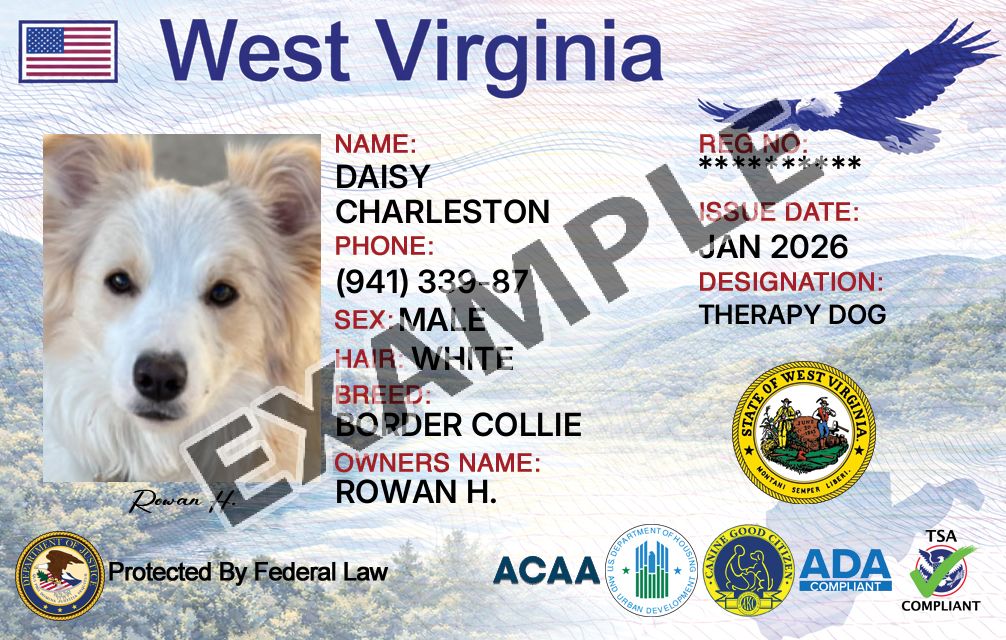
Service Dogs and Emotional Support Animals in Gilmer, West Virginia
If you’re asking where do I register my dog in Gilmer County, West Virginia for my service dog or emotional support dog, the key point is this: service dogs and emotional support animals (ESAs) are not “registered” with a special government program in most cases, but dogs still typically need a local license (often called a dog tax or dog tag) and must meet rabies vaccination requirements.
This landing page explains where to register a dog in Gilmer County, West Virginia using local, official offices, how a dog license in Gilmer County, West Virginia generally works, and how licensing differs from a dog’s status as a service dog or emotional support animal.
Where to Register or License Your Dog in Gilmer County, West Virginia
Because dog licensing is handled locally, the most direct place to start for a dog license in Gilmer County, West Virginia is the county office that administers the annual dog license tax/tag. You may also contact local animal control or county offices for guidance on enforcement, stray/impound questions, and rabies compliance.
Official Offices (Examples) Serving Gilmer County Residents
| Office | Address | Phone | Hours | |
|---|---|---|---|---|
| Gilmer County Assessor’s Office (Dog License / Dog Tax) |
10 Howard Street Glenville, WV 26351 |
304-462-7731 | Not listed | Not listed |
| Gilmer County Clerk (County Commission Clerk / Records) |
10 Howard Street Glenville, WV 26351 |
304-462-7641 | Not listed | Not listed |
| Gilmer County Sheriff’s Office (Law Enforcement) |
10 Howard Street Glenville, WV 26351 |
304-462-7441 | donald.belin@gilmercountywv.gov | Not listed |
| Animal Control (Lewis–Gilmer E-911 Center) |
201 Orchard St Weston, WV 26452 |
304-269-8242 | AnimalControl@LCE-911.com | Not listed |
| City of Glenville (Municipal Contact) |
20 North Court Street Glenville, WV 26351 |
304-462-8040 | thecityofglenville@hotmail.com | Not listed |
Overview of Dog Licensing in Gilmer County, West Virginia
What “Dog Licensing” Means Locally
In Gilmer County, dog licensing is commonly handled as an annual dog license tax (often issued with a physical tag). The local licensing office may refer to it as a dog tag, dog tax, or dog license. Practically, this is what most people mean when they ask where to register a dog in Gilmer County, West Virginia.
Which Office Typically Issues the License
In Gilmer County, dog licensing guidance is published through the Gilmer County Assessor’s Office and indicates the Assessor collects the annual dog license tax and issues tags/receipts. This is the most direct official point of contact for getting a dog license in Gilmer County, West Virginia.
Rabies Vaccination: A Core Requirement
West Virginia law requires rabies vaccination documentation (a rabies certificate and tag) and includes filing of vaccination certificate information with local county offices. In other words, rabies vaccination is not just “recommended”—it’s a major compliance item that supports licensing and enforcement.
How Dog Licensing Works Locally in Gilmer County, West Virginia
Step-by-Step: Getting a Local Dog License (Dog Tag)
- Confirm your dog is vaccinated for rabies and keep the rabies certificate available. If your veterinarian provided a rabies tag, attach it to your dog’s collar.
- Contact or visit the Gilmer County Assessor’s Office to apply and pay the annual fee for your dog license/tag.
- Provide requested owner and dog details (such as owner contact info and basic dog identification).
- Receive your dog tag and receipt and keep records in case you need to show proof for compliance, boarding, travel, or housing.
Timing: Annual Licensing and Local Schedules
Dog licensing is commonly annual, and local notices may specify when the licensing cycle begins and how tags are issued or mailed. If you’re new to the county or recently acquired a dog, call the licensing office to confirm what’s required for first-time licensing and whether documentation should be brought in person or submitted another way.
What If You Live in the City of Glenville?
Licensing is usually handled at the county level, but some residents prefer to double-check municipal expectations—especially if they live inside town limits. If you’re unsure whether any city-specific process applies, contact the City of Glenville and ask whether the city has any additional pet ordinance requirements beyond the county dog license and state rabies rules.
Enforcement and Animal Control Questions
If your question is more about enforcement—such as loose dogs, bites, quarantine guidance, or impound/reclaim procedures—reach out to local animal control. In the Gilmer County area, animal control contact information is published through the Lewis–Gilmer E-911 Center. This is also a practical contact if you’re trying to clarify animal control dog license Gilmer County, West Virginia questions (for example, what proof is required when a dog is reclaimed).
Key Takeaway for “Registration” Questions
When people search where do i register my dog in Gilmer County, West Virginia for my service dog or emotional support dog, they usually need two things: (1) the local dog license/tag and (2) clarity that service dog / ESA status is not created by paying for an online “registration.”
Service Dog Laws in Gilmer County, West Virginia
Service Dog vs. Dog License: Two Different Systems
A service dog is generally defined by the dog being trained to do work or perform tasks for a person with a disability. This legal status is not the same thing as a county dog license. Even if your dog is a trained service dog, you may still need the standard dog license in Gilmer County, West Virginia and you still must follow rabies vaccination requirements.
Do You Need to “Register” a Service Dog with the County?
Typically, no separate county “service dog registration” is required to make a dog a service dog. The dog’s role is based on training and disability-related need, not a purchased certificate. What you do need is to keep your dog properly vaccinated and compliant with local licensing rules so you can demonstrate responsible ownership if questions arise.
Public Access and Practical Documentation
Public-access rights for service dogs are different from licensing requirements. Practically speaking, it helps to keep: rabies vaccination proof, your local dog tag/license receipt, and (if relevant) documentation from a trainer or program (not required by licensing, but sometimes helpful for clarifying misunderstandings). Keep in mind that a local dog license does not “grant” public access—those rules come from disability law.
Emotional Support Animal Rules in Gilmer County, West Virginia
ESA vs. Dog License: What Changes (and What Doesn’t)
An emotional support animal (ESA) is not the same as a service dog. An ESA generally supports a person’s mental or emotional health, and the most common legal context is housing. Even if your dog is an ESA, the county can still require a regular dog license in Gilmer County, West Virginia, and rabies vaccination requirements still apply.
Do ESAs Have Public-Access Rights Like Service Dogs?
Generally, no. ESAs are not automatically allowed everywhere pets are prohibited. Many places of public accommodation must allow service dogs, but ESAs do not have the same broad public-access status. If your goal is access to public spaces, it’s important to understand the difference so you don’t waste time pursuing “ESA registration” that doesn’t change public-access rules.
Housing Documentation (Separate from Licensing)
While the county dog license process focuses on identification, fees, and vaccination compliance, ESA requests for housing typically involve documentation from a qualified professional. That documentation is used for housing accommodations—not for county licensing—and it does not replace local licensing requirements.
Frequently Asked Questions
Register A Dog In Other West Virginia Counties
Select your county below to get started with your dog’s ID card. Requirements and license designs may vary by county, so choose your location to see the correct options and complete your pup’s registration.
- Barbour County Dog Registration
- Berkeley County Dog Registration
- Boone County Dog Registration
- Braxton County Dog Registration
- Brooke County Dog Registration
- Cabell County Dog Registration
- Calhoun County Dog Registration
- Clay County Dog Registration
- Doddridge County Dog Registration
- Fayette County Dog Registration
- Grant County Dog Registration
- Greenbrier County Dog Registration
- Hampshire County Dog Registration
- Hancock County Dog Registration
- Hardy County Dog Registration
- Harrison County Dog Registration
- Jackson County Dog Registration
- Jefferson County Dog Registration
- Kanawha County Dog Registration
- Lewis County Dog Registration
- Lincoln County Dog Registration
- Logan County Dog Registration
- Marion County Dog Registration
- Marshall County Dog Registration
- Mason County Dog Registration
- McDowell County Dog Registration
- Mercer County Dog Registration
- Mineral County Dog Registration
- Mingo County Dog Registration
- Monongalia County Dog Registration
- Monroe County Dog Registration
- Morgan County Dog Registration
- Nicholas County Dog Registration
- Ohio County Dog Registration
- Pendleton County Dog Registration
- Pleasants County Dog Registration
- Pocahontas County Dog Registration
- Preston County Dog Registration
- Putnam County Dog Registration
- Raleigh County Dog Registration
- Randolph County Dog Registration
- Ritchie County Dog Registration
- Roane County Dog Registration
- Summers County Dog Registration
- Taylor County Dog Registration
- Tucker County Dog Registration
- Tyler County Dog Registration
- Upshur County Dog Registration
- Wayne County Dog Registration
- Webster County Dog Registration
- Wetzel County Dog Registration
- Wirt County Dog Registration
- Wood County Dog Registration
- Wyoming County Dog Registration